

Poor knowledge management doesn't announce itself. It doesn't show up as a line item. It shows up as a new hire still piecing things together six weeks in. A product update that never made it past a Slack thread. A process question answered differently every time someone asks.
The costs are real, they're large, and most organizations are absorbing them quietly. Here's what the research actually says.
Statistics on the cost of poor internal knowledge management
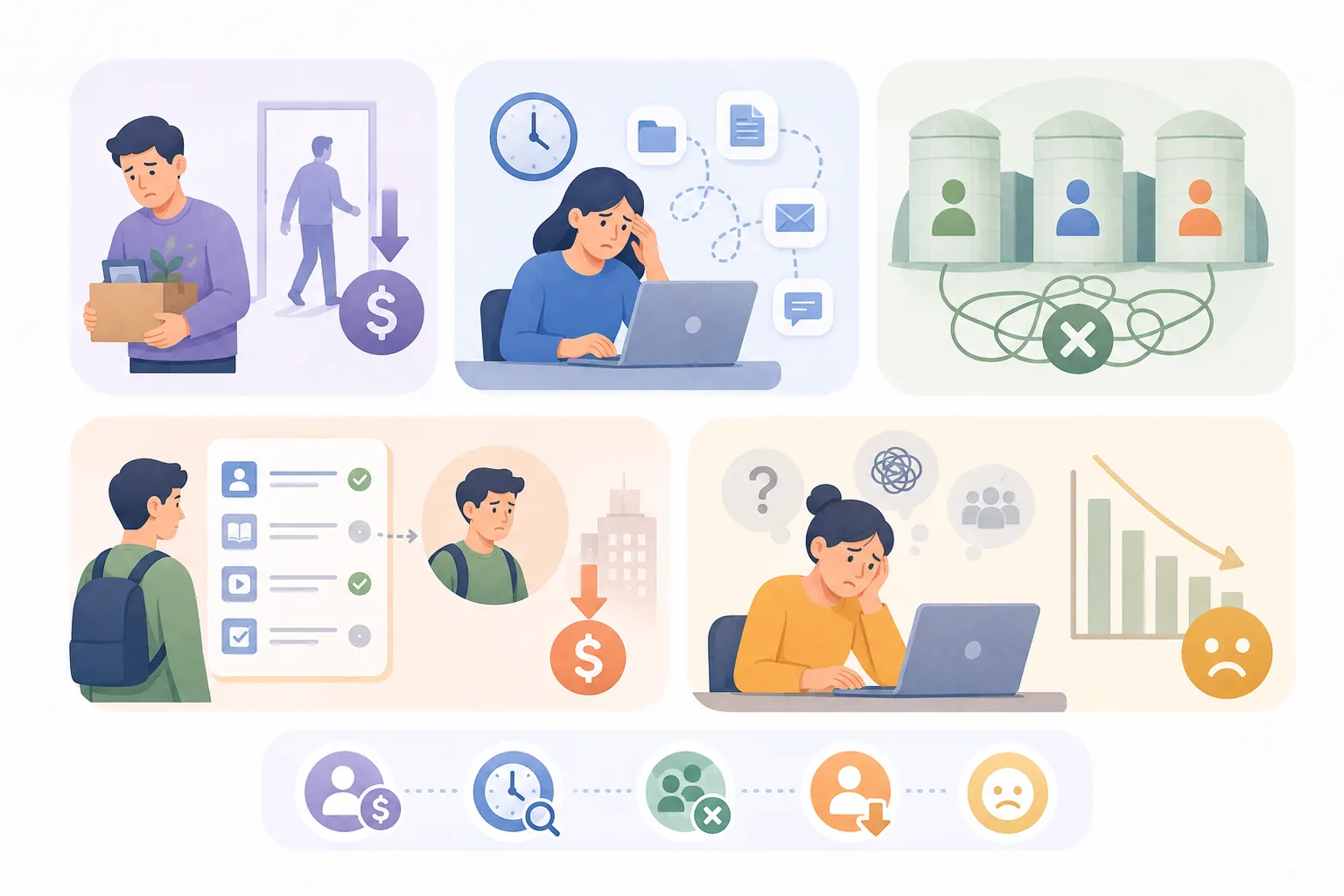
Knowledge is one of your company's most valuable assets. For most organizations, it's also one of the most poorly managed. It stays trapped in shared drives, buried in inboxes, and locked inside the heads of experienced employees. The cumulative effect is a slow, invisible drain on productivity, retention, and operational efficiency.
These five categories of statistics make the financial impact impossible to ignore.
What employee turnover really costs
When someone leaves, they take more than their role. They take tribal knowledge, shortcuts, and institutional context. Unless that knowledge was documented somewhere findable, it's gone.
- Replacing a single employee can cost anywhere from half to four times their annual salary, per Applauz. For a $60,000 role, that's up to $240,000 out the door.
- Voluntary turnover costs U.S. businesses more than $1 trillion per year, per Gallup.
- Inefficient knowledge sharing costs large U.S. businesses an average of $47 million annually in lost productivity. (Panopto, 2018)
- Fortune 500 companies lose an estimated $31.5 billion a year by failing to share critical information, per IDC.
What this means for your team
Every departure is a knowledge loss event. Without a central repository for company knowledge, you're not just losing a person. You're losing everything they knew that was never written down.
Wasted hours: what poor knowledge access costs
The average employee isn't failing to work hard. They're working hard in the wrong direction, searching for information they shouldn't have to hunt for.
- Employees spend 1.8 hours every day searching for information that already exists inside their organization, per McKinsey. That's nearly a full workday lost per week, per person.
- Employees waste an average of 10% of their workweek hunting for relevant information, per Bloomfire's Value of Enterprise Intelligence 2025 report.
- Knowledge workers waste 21% of their time searching and another 14% recreating information, per Gartner.
- Inefficiency costs businesses an average of 25% of annual revenue, per Bloomfire. For a $9 billion company, that's $2.4 billion in lost enterprise value each year.
What this means for your team
Time searching is time not building, selling, or supporting. Employees spend hours recreating information that already exists because it's not findable. Knowledge buried in shared drives and disconnected tools doesn't get used. When it lives inside a structured, shareable format delivered through Slack, where your team already works, that wasted time shrinks fast.
Pro tip: When knowledge lives inside Slack, employees stop searching and start finding. Here's how knowledge sharing actually works in practice.
How knowledge hoarding slows your company down
Siloed systems don't just frustrate employees. They actively damage your company's ability to move fast and stay competitive.
- Siloed knowledge slows cross-functional collaboration by up to 30%, leading to redundant work and misalignment, per Bloomfire.
- Per Asana, 60% of work time is spent on "work about work": searching, switching between multiple systems, managing communications. Only 40% goes to the skilled work employees were actually hired to do.
- Poor data quality, a direct byproduct of fragmented knowledge, costs the average organization $12.9 million per year, per Gartner.
- According to the KM World Survey Report, 54% of organizations use more than five platforms for documenting and sharing information. Most employees can't navigate all of them.
- 69% of organizations cite effective knowledge management as a key driver of competitive advantage. (WifiTalents)
What this means for your team
Knowledge that remains isolated isn't neutral. It slows strategic decisions, increases operational costs, and creates missed opportunities. Centralizing knowledge into formats teams can return to repeatedly is what separates fast-moving companies from stuck ones.
The hidden cost of slow onboarding
Via High5Test
Onboarding is one of the most expensive knowledge problems most companies are still treating as a checklist.
- Nearly 1 in 3 new hires leaves within the first 90 days. (Jobvite, via FirstHR)
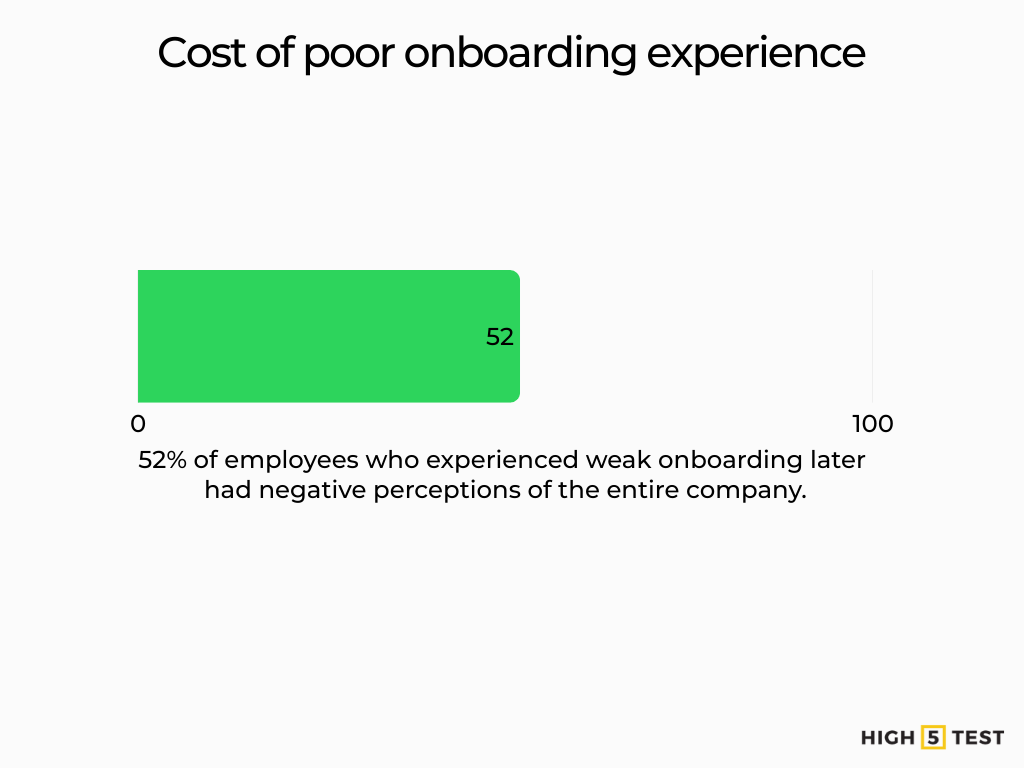
- 52% of employees who experienced weak onboarding later developed negative perceptions of their entire company. (High5Test)
- The average cost to onboard a single employee is $4,700, per SHRM. When that person leaves in the first 90 days, that investment disappears entirely. (FirstHR)
- Companies with structured onboarding see 82% better retention and 70% higher productivity from new hires. (FirstHR)
- 46% of managers say it takes too long to get new employees up to speed. 44% report that new hire training time has increased over the past five years. (CAKE)
What this means for your team
Outdated knowledge and incomplete information during onboarding is a retention and revenue problem. Structured, trackable resources, the kind teams return to repeatedly, close the gap between day one and full contribution.
Pro tip: You don't need to overhaul your LMS to fix onboarding. You need to turn what your team knows into something new hires can actually use. Here's the difference between knowledge transfer and a traditional LMS.
The morale cost of knowledge gaps
Fragmented knowledge slows teams down and demoralizes them.
- Global employee engagement fell to 21% in 2024. Gallup estimates this cost the world economy $438 billion in lost productivity that year alone.
- 60% of employees find it difficult, very difficult, or nearly impossible to get the information they need from colleagues to do their jobs, per Panopto.
- Poor knowledge management leads to constant frustration; insufficient information breeds the sense that the company doesn't trust employees with what they need. (Assima)
What this means for your team
The employee experience is shaped by access. When critical information stays outdated or isolated, employees struggle and disengage. Treating knowledge as a living operational resource, not a one-time training event, is what keeps people informed, capable, and connected.
The real cost of doing nothing about poor knowledge management
The numbers in this article exist to name something most teams already feel but can't quantify.
Every hour spent searching for a file that should be findable. Every new hire who leaves feeling under-supported. Every product update that never made it past a Slack thread. It all adds up quietly, consistently, and at scale.
This doesn't require a platform overhaul. It requires getting knowledge out of static storage and into the flow of how your team works. That's what Coassemble is built for — helping teams turn what they know into structured, trackable resources, delivered inside Slack where work actually happens.
FAQs on the cost of poor internal knowledge management
What is the cost of poor knowledge management?
Poor knowledge management costs organizations through lost productivity, slow onboarding, employee disengagement, and knowledge silos. Fortune 500 companies alone lose an estimated $31.5 billion annually by failing to share critical information, per IDC.
How does poor knowledge management affect productivity?
Employees spend an average of 1.8 hours daily searching for information that already exists, per McKinsey. Knowledge workers also waste 21% of their time hunting for information and another 14% recreating it, per Gartner.
What are knowledge silos and why do they matter?
Knowledge silos occur when critical information stays trapped in disconnected tools, teams, or individuals. They slow decision-making, create redundant work, and damage company culture over time.
How can teams fix poor knowledge management without building a new system?
Start by getting knowledge out of static docs and into structured, trackable resources. Deliver them through Slack where work already happens. Tools like Coassemble plug into existing workflows without replacing them.